Following the argument in lecture last Thursday that radical translation is impossible and that all understanding between civilisations is necessarily indeterminate, here are links to the two philosphical justifications I used.
A good presentation of Quine's "gavagai" thought experiment is here.
The argument is in Quine's Word & Object, on Course Reserve.
Thomas Nagel's What is it Like to be a Bat? is on-line here (as well as being on Course Reserve.)
Tuesday, January 31, 2006

Field Trip to Nitobe Gardens
Follow this link to the Nitobe Gardens: I will have a date shortly for our field trip and Japanese-food feast. Update: I am arranging a tour guide with the UBC Botanical Gardens Society & will post the date when I finalise with them.
For those who are not close enough to UBC to make a direct trip efficient, a carpool would seem to be the preferred option of travel. I can take six people: please add your vehicle capacity in the comments section. Perhaps carpool drivers (me excepted) could be made exempt from the collection of funds (a fiver each?) for our feast on the day?
A volunteer treasurer is needed for this event .....
For those who are not close enough to UBC to make a direct trip efficient, a carpool would seem to be the preferred option of travel. I can take six people: please add your vehicle capacity in the comments section. Perhaps carpool drivers (me excepted) could be made exempt from the collection of funds (a fiver each?) for our feast on the day?
A volunteer treasurer is needed for this event .....
Nitobe Gardens in Pictures (to music)
 Classfellow Raymond uploaded pictures he took during our field trip to Nitobe Gardens last term, here. You will also find audio clips of traditional Japanese music on his file list. They are all very well done, and some of them are absolutely stunning. Click on this sample picture for the full effect.
Arigato Gozaimashita, Raymond-san.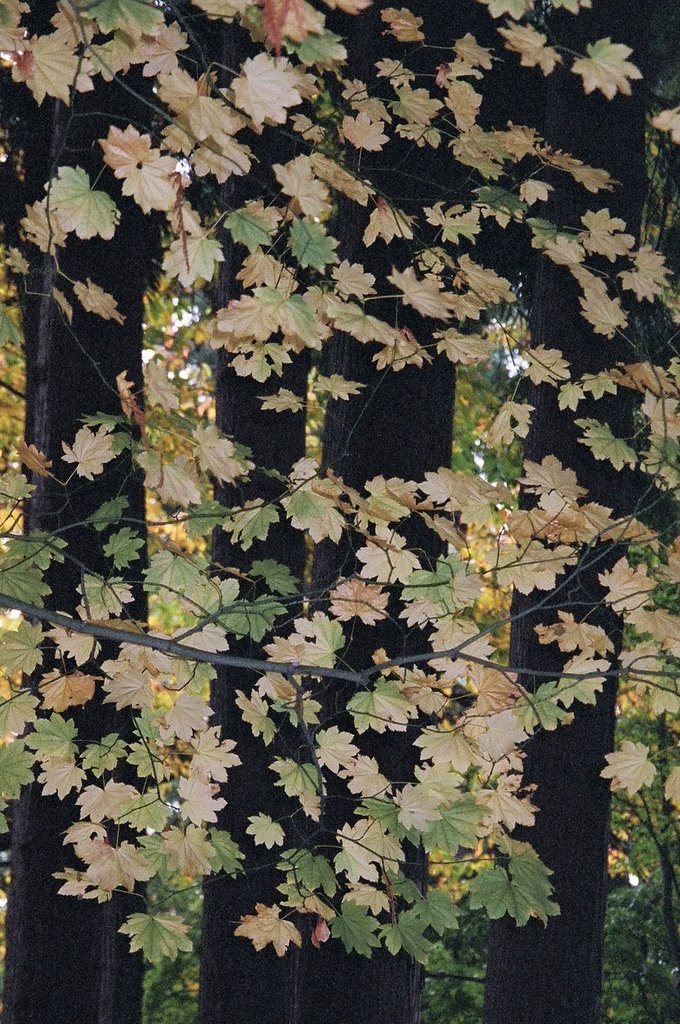 The SFU Librarian who accompanied us on our Nitobe tour also took pictures and send us this as her most evocative shot of Nitobe Garden's Japanese aesthetic.
Group Assignments
Please use this post to let your classfellows know, using the "comments," your group blog name, url & membership (initials are quite fine for the latter information.)
Group Project: Criteria & Detail
The Group project is designed to be straightforward, enjoyable, and beneficial. Each group will create and maintain a Web Log about one aspect of the course primary texts. This can include a focus on the social, political or religious background.
You have now completed the blogger tutorial and have been assigned to a Group.
The manner of approach to, and treatment of, your text is entirely for your Group to decide. This assignment offers you the opportunity to enhance, challenge or re-invent the specific focus of both the lectures and your seminar discussions.
The grading criteria are the scope, originality, inventiveness and literary insight of the accumulated blog entries. Technical proficiency will not be graded, but of course you are free to use any mechanical technique you wish. I will publish all the Groups' blog addesses on the Course blog and you are encouraged to solicit advice & criticism from the whole class throughout the course of the semester. Open collaboration is one great strength of blogging: some scholars, for instance, post parts of articles or even books in the blogosphere for criticism and correction before publication.
Of course, I am available for expert consultation: in person during Office Hours, and online most times.
Because this is a Group project, you will find that synergy will soon animate and enlived the assignment. I offer the suggestion that each Group assign responsibilities to members based on individual proficiencies and preferences. For instance, in principle, only one member need do the mechanics of posting the collaborative entries. There will be one group grade for all members.
I will take a snapshot of your blog on the day of the last seminar of the term and use that for grading: however I will look in regularly throughout the term as a means to, shall we say, encourage you not to leave the whole enterprise until the last minute. The experience of blogging regularly for a couple of months will, I believe, be its own benefit to you down the years.
Here is a link or three to some blogging of mine on How to Blog Effectively.
You have now completed the blogger tutorial and have been assigned to a Group.
The manner of approach to, and treatment of, your text is entirely for your Group to decide. This assignment offers you the opportunity to enhance, challenge or re-invent the specific focus of both the lectures and your seminar discussions.
The grading criteria are the scope, originality, inventiveness and literary insight of the accumulated blog entries. Technical proficiency will not be graded, but of course you are free to use any mechanical technique you wish. I will publish all the Groups' blog addesses on the Course blog and you are encouraged to solicit advice & criticism from the whole class throughout the course of the semester. Open collaboration is one great strength of blogging: some scholars, for instance, post parts of articles or even books in the blogosphere for criticism and correction before publication.
Of course, I am available for expert consultation: in person during Office Hours, and online most times.
Because this is a Group project, you will find that synergy will soon animate and enlived the assignment. I offer the suggestion that each Group assign responsibilities to members based on individual proficiencies and preferences. For instance, in principle, only one member need do the mechanics of posting the collaborative entries. There will be one group grade for all members.
I will take a snapshot of your blog on the day of the last seminar of the term and use that for grading: however I will look in regularly throughout the term as a means to, shall we say, encourage you not to leave the whole enterprise until the last minute. The experience of blogging regularly for a couple of months will, I believe, be its own benefit to you down the years.
Here is a link or three to some blogging of mine on How to Blog Effectively.
Makura no Soshi: Reading
A reminder that to be comfortably on schedule, be read this week to section 99 of Makura no Soshi [ 枕草子 ] - Pillow Tales by Sei Shonagon [ 清少納言] circa 1000 AD.
Following up on my comment that "Sei Shonagon" is not the author's name as we understand people's names, "shonagaon"[ 少納言 ] is Heian Japanese for "[minor] councillor" - in other words, an honorific way to designate her court function - and "Sei" [ 清 ] is an alternative way to read the name of the clan-family into which she was born: specifically "Kiyohara" [ 清原 ].
This is similar to the name "Genji" - Gen [ 源 ] is an alternative way to read the kanji for "Minamoto" and ji [ 氏 ] is a kanji for "family." As we will hear, "Genji"'s father, the Emperor, decided for political reasons (mainly one of his mothers-in-law playing Agrippina) to make him a commoner and thus bestowed on him the honourary surname "Minamoto" customary in such occasions.
Following up on my comment that "Sei Shonagon" is not the author's name as we understand people's names, "shonagaon"[ 少納言 ] is Heian Japanese for "[minor] councillor" - in other words, an honorific way to designate her court function - and "Sei" [ 清 ] is an alternative way to read the name of the clan-family into which she was born: specifically "Kiyohara" [ 清原 ].
This is similar to the name "Genji" - Gen [ 源 ] is an alternative way to read the kanji for "Minamoto" and ji [ 氏 ] is a kanji for "family." As we will hear, "Genji"'s father, the Emperor, decided for political reasons (mainly one of his mothers-in-law playing Agrippina) to make him a commoner and thus bestowed on him the honourary surname "Minamoto" customary in such occasions.
Buddhist Background to Japanese Æsthetics
I found reputable links to pages detailing Buddhist doctrine which, as detailed in today's lecture, forms part of the background to Makura no soshi and Genji monogatari, the Heian culture, and eventually the Japanese civilisation æsthetic.
An explanation of mujokan that is both informative & delightful can be found via this link.
The iroha gets bloggy treatment here and here. More regular here, here and at Monash U. I have not readily found anything marvelous online about the iroha. If anyone has a particular interest, I will bring in a book from my own collection.
Wednesday, January 25, 2006
Turning Japanese at "Higher Grounds"
If you want to experience turning Japanese here at SFU, follow this. Go to the Higher Grounds and walk up to the new automatic glass doors. As you may have found out, there is a delay in the doors starting to open which causes you to stand there and adds that little shot of frustration.
Well the next time you are there, go up to the doors, bow from the waist like a Japanese, and you'll find that when you return to upright the doors will be open. Sugoi desu.
Well the next time you are there, go up to the doors, bow from the waist like a Japanese, and you'll find that when you return to upright the doors will be open. Sugoi desu.
Yes! Room Change for Tuesdays
Join me in giving thanks for our hardworking University staff -- Ms. Linda Elliot in our Department office & the good people at the Office at the Registrar -- who have found us a wonderful room for our Tuesday class. AQ4130 has sunlight from above, wide open spaces & a pleasant lounge outside.
Tuesday, January 24, 2006
Japanese Æsthetic Concepts
 My method in our course for presenting the unique and uniquely pervasive æsthetic concepts that identify the Japanese civilisation is Baconian induction: begin with simple particular concepts, add more complex ones which incorporate the simple, and conclude with the metaphysic which comprehends them all.
A summary list of simple æsthetics, relevant to the civilisation literature, presented in lecture to date is as follows.
- mono no aware (the poignant sadness of things.) The indeterminacy of translation is salient here, for this elusive concept is comprehensible ever more properly only in degrees as one's (in practice, impossible) immersion (or, requisitely, conversion) into Japanese civilisation increases. The word aware is frequent in Genji, and centuries of Japanese commentators have marked it down as the story's dominant mood: a mood that leads the reader to a sense of it, thus, a cultivated sensibility, termed mono no aware: widened, through Genji's cultural influence, from a literary æsthetic principle to a defining cultural æsthetic. There is a compounding nature operative here, as the individual's cultivated growth in mono no aware is itself mono that induces aware.
- shichi-go-san (three-five-seven.) The assymetry of the three odd numbers induces a move to completion. Embedded in the divinations of the Shinto-Buddhist syncreticism, the contemporary vestige is the Girls' Festival and Boys' Festival. Tripartite asymmetries of this type are a subtle & effective universal organising mode in Japanese literatures.
- ten-chi-jin (heaven-earth-man.) In several Japanese cultural forms -- one school of ikebana for instance, and Noh drama -- a sense of something high, something low. and an intermediary: the axes are spacial, temporal and human. The middle concept is (explicit in the configuration of the Noh stage) a bridge -- with significance that, as with anything of Japan, does not map faciley onto any similar or seemingly identical Western forms.
- shin-gyo-so (true, moving & grass-like.) In calligraphy, block-style, kana & cursive; in the cha-no-yu, of its implements, formal, semi-formal, informal. Shin-gyo-so is an effective schema for mapping the uniquely Japanese manner of reacting to any discrete new foreign encounter. Evident in literature in comparative representations, structural contrasts and developments in character.
- jo-ha-kyu (gathering, break, urgent action.) A concept exemplified by -- & likely originating in contemplation of -- the waterfall. In literature -- notably haiku -- it signifies introduction, development, action. In music, it has several compounding applications, essentuially a triptych of increasing rapidity & climax. This is accepted as the natural rythmn -- gestation, birth, life is just one obvious univeral triad.
I'll blog the remaining concepts pertinent to out study of Genji as my series of lectures progress.
Friday, January 20, 2006
Books on Course Reserve
 As mentioned, I will be adding pertinent books to our Course Reserve at the Library as the lectures and seminars develop through the term.
I might draw your attention to this short but engaging book as being congenial to some of you based on our one-on-one discussions vis a vis contemporary Japan. You will find a list of online reviews here.
Update: Here is the link to our Course Reserve.
On your Oral Presentations
Your oral presentations do allow room to accomodate your personal encounter with Tales of Genji. Now, in support of the thesis for our course, I happen to be best interested in the variety and potency of Lady Shikibu's character portaits of the women in Genji's life. As the lectures will further develop, my vector into Tales of Genji at this stage of my (likely, life-long) encounter with the great work is that the female characters are the strength of the text and its structural centre -- Prince Genji is portrayed in his relation to each of the female characters as a (personal-political and erotic) idealisation of what masuclinity represents for her.
So, if your presentations add to our depth of understanding of any of the many female characters -- for example, in relation to their setting or significant proximate flora -- all to the good. You might also wish (or not) to cast your presentation in terms of any of the Japanese æsthetic concepts introduced in lecture.
But, that all being said, if your find some feature of Genji that captures your interest and is unrelated to any of these dimensions of the text, you are certainly encouraged to take your preferred approach. Simply discuss with me in advance, according to the criterion listed in the syllabus.
Schedule
January 31st: K.I.
February 2nd: M.H. February 7th: A.O.
February 9th: H.M., C.G. February 14th: K.V.L., M.E.
February 16th: M.Z., L.J. February 23rd: R.L., A.C.
February 28th: J.A., K.I. March 2nd: S.B., O.G.
March 7th: M.W. March 9th: C.L.
March 14th: S.M. March 16th: R.M., J.R.
March 21th: M.R. March 23rd: H.B.
March 28th: G.W. March 30th: A.O'S.
April 8th: A.W.
So, if your presentations add to our depth of understanding of any of the many female characters -- for example, in relation to their setting or significant proximate flora -- all to the good. You might also wish (or not) to cast your presentation in terms of any of the Japanese æsthetic concepts introduced in lecture.
But, that all being said, if your find some feature of Genji that captures your interest and is unrelated to any of these dimensions of the text, you are certainly encouraged to take your preferred approach. Simply discuss with me in advance, according to the criterion listed in the syllabus.
Schedule
January 31st: K.I.
February 2nd: M.H. February 7th: A.O.
February 9th: H.M., C.G. February 14th: K.V.L., M.E.
February 16th: M.Z., L.J. February 23rd: R.L., A.C.
February 28th: J.A., K.I. March 2nd: S.B., O.G.
March 7th: M.W. March 9th: C.L.
March 14th: S.M. March 16th: R.M., J.R.
March 21th: M.R. March 23rd: H.B.
March 28th: G.W. March 30th: A.O'S.
April 8th: A.W.
Thursday, January 19, 2006
"the little hagi frond"
 This delightful drawing of the hagi (lespedeza japonica) frond to which Genji is poetically referred by his father, the Emperor, in the Kiritsubo chapter is online courtesy of jomon.com
The Chinese style of the painting suits the Heian period of imitation in art and culture - the first stage of the shin-gyo-so process.
Update: A delightful page with a clickable index of flora in Genji that contains pictures and names of each that link to their source sentences from the text.
Tuesday, January 17, 2006
Course Syllabus
Reading Schedule:
We will be reading our main text, Tales of Genji, throughout the term, with the Pillow Book as counterpoint and embellishment. This schedule of readings gives you an effective way to manage your reading: you will in all likelihood want to read well ahead of the schedule, but if you do follow the schedule as written here you will never be behind the lectures.
The weekly schedule for Genji is divided along some structual seams in the text and requires roughly one hundred pages per week. Especially when one considers that Lady Shikibu was not an Experimental Modernist, and wrote to delight, this is anything but onerous! For me, the experience of reading Genji added to my life's treasures.
Week One: January 10th & 12th
Genji: Ch 1
Pillow Book: Sec. 1
Week Two: January 17th & 19th
Genji: Ch. 2-4
Pillow Book: Sec 2-8
Week Three: January 24th & 26th
Genji: Ch. 5-9
Pillow Book: Sec. 9-49
Week Four: January 31st & February 2nd
Genji: Ch. 10-14
Pillow Book: Sec. 50-99
Week Five: February 7th & 9th
Genji: Ch. 15-21
Pillow Book: Sec. 100-149
Week Six: February 14th & 16th
Genji: Ch. 22-31
Pillow Book: Sec. 150-185
Week Seven: February 23rd
Genji: Ch. 32-35
Week Eight: February 28th & March 2nd
Genji: Ch. 36-41
Week Nine: March 7th & 9th
Genji: Ch. 42-46
Week Ten: March 14th & March 16th
Genji: Ch. 47-50
Week Eleven: March 21st & March 23rd
Genji: Ch. 51-54
Week Twelve: March 28th & March 30th
Masks: (Read all)
Week Thirteen: April 3rd & 5th
Masks (con't.) & course reflections.
See support material available on Library Reserve.
Assignment Deadlines.
Nb: There is a 3% per day late penalty for assignments -- documented medical or bereavement leave excepted -- and all assignments must be placed in the Instructor's mailbox outside the English Department Office.
1. Mid term paper, twenty-five hundred words: due midnight March 6th. Assignment sheet with suggested topics will be blogged on February13th. Criteria include literary analysis, engagement with course themes and writing mechanics. [Note that these dates afford you flexibility. If your mid-term schedule is crowded, you are free to submit your paper at the deadline, which is more than three weeks after the assignment sheet is distributed. If you prefer to get a critical response to your paper earlier in the course, you can submit yours as soon as you like after the assignment is blogged, in week six.]
2. Group e-text project: in collaboration with the Course Instructor, create a web log dedicated to a distinct topic the works from the course reading list. Groups set & assignment sheet handed out January 31st. Seminar time will be set aside throughout the term to work with the Instructor on this project
3. Individual class presentation: schedule handed around in seminar. You will choose any one of the chapters from Genji and prepare an oral presentation of no less than five & no more than ten minutes that gives your reflection on the nani [ 何 ], the kosei [ 個性 ] -- the what, or the quiddity -- that seperates Genji from Madame Butterfly as it is appears in the interaction between Genji and any one of his lovers in your selected chapter. To help all of us increase our understanding of, & appreciation for, Shikibu's art, please include some detail and explanation on any aspect of the setting or the plant or flower with which the female character is associated. Be sure to choose one that you find engaging or interesting, emembering that as none of us have significant knowledge of Japan, any researched information that you provide will be warmly received.
Your presentation will be a good opportunity for you to get your toe in the water to a hopeful topic or area of interest for your Final Paper.
4. Final Paper, thirty-five hundred words: due at midnight April 7th. Topic to be discused and approved in advance with the course instructor.
Course Approach
It is hoped that students will engage the material critically.
Course requirement weighting:
10% Course participation
10% Seminar presentation
20% Group e-Text project
20% Mid-term paper (approx. 2500 words)
40% Final Paper (approx. 3500 words)
Nb: “Participation requires both participation in seminar and attendance and punctuality at lecture and seminar."
Instructor Contact:
Office Hours: AQ 6094 -- Monday 11:30-13:30; Tuesday 13:30-15:00; Wednesday, 11:30–15:00; Thursday 13:30-15:00. Bring your coffee and discuss course matters freely. E-mail to ogden@sfu.ca will be received from campus e-mail accounts only, & will be replied to within fourty-eight hours. The URL for this course blog is http://talesofgenji.blogspot.com
In emergencies, I can be reached on my cellular phone at 604-250-9432.
We will be reading our main text, Tales of Genji, throughout the term, with the Pillow Book as counterpoint and embellishment. This schedule of readings gives you an effective way to manage your reading: you will in all likelihood want to read well ahead of the schedule, but if you do follow the schedule as written here you will never be behind the lectures.
The weekly schedule for Genji is divided along some structual seams in the text and requires roughly one hundred pages per week. Especially when one considers that Lady Shikibu was not an Experimental Modernist, and wrote to delight, this is anything but onerous! For me, the experience of reading Genji added to my life's treasures.
Week One: January 10th & 12th
Genji: Ch 1
Pillow Book: Sec. 1
Week Two: January 17th & 19th
Genji: Ch. 2-4
Pillow Book: Sec 2-8
Week Three: January 24th & 26th
Genji: Ch. 5-9
Pillow Book: Sec. 9-49
Week Four: January 31st & February 2nd
Genji: Ch. 10-14
Pillow Book: Sec. 50-99
Week Five: February 7th & 9th
Genji: Ch. 15-21
Pillow Book: Sec. 100-149
Week Six: February 14th & 16th
Genji: Ch. 22-31
Pillow Book: Sec. 150-185
Week Seven: February 23rd
Genji: Ch. 32-35
Week Eight: February 28th & March 2nd
Genji: Ch. 36-41
Week Nine: March 7th & 9th
Genji: Ch. 42-46
Week Ten: March 14th & March 16th
Genji: Ch. 47-50
Week Eleven: March 21st & March 23rd
Genji: Ch. 51-54
Week Twelve: March 28th & March 30th
Masks: (Read all)
Week Thirteen: April 3rd & 5th
Masks (con't.) & course reflections.
See support material available on Library Reserve.
Assignment Deadlines.
Nb: There is a 3% per day late penalty for assignments -- documented medical or bereavement leave excepted -- and all assignments must be placed in the Instructor's mailbox outside the English Department Office.
1. Mid term paper, twenty-five hundred words: due midnight March 6th. Assignment sheet with suggested topics will be blogged on February13th. Criteria include literary analysis, engagement with course themes and writing mechanics. [Note that these dates afford you flexibility. If your mid-term schedule is crowded, you are free to submit your paper at the deadline, which is more than three weeks after the assignment sheet is distributed. If you prefer to get a critical response to your paper earlier in the course, you can submit yours as soon as you like after the assignment is blogged, in week six.]
2. Group e-text project: in collaboration with the Course Instructor, create a web log dedicated to a distinct topic the works from the course reading list. Groups set & assignment sheet handed out January 31st. Seminar time will be set aside throughout the term to work with the Instructor on this project
3. Individual class presentation: schedule handed around in seminar. You will choose any one of the chapters from Genji and prepare an oral presentation of no less than five & no more than ten minutes that gives your reflection on the nani [ 何 ], the kosei [ 個性 ] -- the what, or the quiddity -- that seperates Genji from Madame Butterfly as it is appears in the interaction between Genji and any one of his lovers in your selected chapter. To help all of us increase our understanding of, & appreciation for, Shikibu's art, please include some detail and explanation on any aspect of the setting or the plant or flower with which the female character is associated. Be sure to choose one that you find engaging or interesting, emembering that as none of us have significant knowledge of Japan, any researched information that you provide will be warmly received.
Your presentation will be a good opportunity for you to get your toe in the water to a hopeful topic or area of interest for your Final Paper.
4. Final Paper, thirty-five hundred words: due at midnight April 7th. Topic to be discused and approved in advance with the course instructor.
Course Approach
It is hoped that students will engage the material critically.
Course requirement weighting:
10% Course participation
10% Seminar presentation
20% Group e-Text project
20% Mid-term paper (approx. 2500 words)
40% Final Paper (approx. 3500 words)
Nb: “Participation requires both participation in seminar and attendance and punctuality at lecture and seminar."
Instructor Contact:
Office Hours: AQ 6094 -- Monday 11:30-13:30; Tuesday 13:30-15:00; Wednesday, 11:30–15:00; Thursday 13:30-15:00. Bring your coffee and discuss course matters freely. E-mail to ogden@sfu.ca will be received from campus e-mail accounts only, & will be replied to within fourty-eight hours. The URL for this course blog is http://talesofgenji.blogspot.com
In emergencies, I can be reached on my cellular phone at 604-250-9432.
Friday, January 13, 2006
Japanese Pronunciation
You may not be interested in Japanese pronunciation; and if you are not, it will make absolutely no difference whatsoever to your sucess in or enjoyment of this course.
If you are interested in Japanese pronunciation, which is very easy to emulate, there is a exceptional website here, which includes clickable sounds and International Phonetic Association symbols, and simple teach-yourself sections.
Japanese words are pronounced regularly: so regularly in fact that they are metronomyic - that is, they have equal time-stress on each unit in a spoken word. These units in Japanese are vowels and combinations of a consonant and a vowel (called morae by the IPA.) So, except for "n" there are really no stand-alone consonants in Japanese (click here for the finer details of this point.)
These morae are represented by the Japanese in symbols called kana. Japanese actually use two different sets of kana to write their language. (It's as if we had two different alphabets for the same letters!) One set of kana called hiragana is used to write native Japanese. The second set, called katakana, is used to write foreign words, words requiring emphasis, or, these days, commercial advertisements. (The hot links will take you to a syllabary table with sounds and IPA symbols.)
Note from the two syllabaries that there are stand-alone vowels. Japanese is like Latin in this respect, that it has pure vowel sounds only: five sounded short, and five more when doubled to sound long. You can click to a syllabary table of Japanese vowels only, again with sounds & IPA symbols.
There are, naturally, some small complications - none of which effect our reading at all.
If you are interested in Japanese pronunciation, which is very easy to emulate, there is a exceptional website here, which includes clickable sounds and International Phonetic Association symbols, and simple teach-yourself sections.
Japanese words are pronounced regularly: so regularly in fact that they are metronomyic - that is, they have equal time-stress on each unit in a spoken word. These units in Japanese are vowels and combinations of a consonant and a vowel (called morae by the IPA.) So, except for "n" there are really no stand-alone consonants in Japanese (click here for the finer details of this point.)
These morae are represented by the Japanese in symbols called kana. Japanese actually use two different sets of kana to write their language. (It's as if we had two different alphabets for the same letters!) One set of kana called hiragana is used to write native Japanese. The second set, called katakana, is used to write foreign words, words requiring emphasis, or, these days, commercial advertisements. (The hot links will take you to a syllabary table with sounds and IPA symbols.)
Note from the two syllabaries that there are stand-alone vowels. Japanese is like Latin in this respect, that it has pure vowel sounds only: five sounded short, and five more when doubled to sound long. You can click to a syllabary table of Japanese vowels only, again with sounds & IPA symbols.
There are, naturally, some small complications - none of which effect our reading at all.
- A consonant can be pronounced longer than usual, and those cases are represented in writing by a subscript kana for the morae "tu."
- There is a "y" sound in Japanese that is included in a single morae but is represented in writing by an additional kana: a subscript from one of the three "Y" kana - Ya, Yu, Yo.
- Some morae in one consonant+vowel series -- such as Sa, Si, Su, Se, So -- have irregular sounds. For example, in the "S" consonant series used here, the actual pronunciation is represented in Romanised English as Sa, Shi, Su, Se, So.
- There is a set of paired kana to write morae for imported words.
- Some lesser-used consonants -- P, B, D, Z, G -- don't have their own kana for their consonant+vowel set, but use kana from other sets of morae with a mark added beside it: either a quotation mark or a superscript "o."
Anyway, the website linked in this post's title gives you much more.
The international phonetic chart for vowels is helpfully hosted online by the IPA.
If you are interested in kanji -- the ideographic system of writing brought to Japan from China via Korea - you may enjoy Kanji Alive. Incidently, Japan can be said to have come to Japan via Korea .....
Thursday, January 12, 2006
Death By Japanese Food
Method of Approach
Update: Engl-394-D2 students are encouraged to use this post as a "suggestion box" for comments -- anonoymous or otherwise -- on how the course may be improved as it goes on. (20/01/06)
It would be good to hear from each of severally you on what you think would be the method most beneficial to you of working directly with our central text, Tales of Genji, over the course of the term.
My plan is this. Each class will have one hour of lecture from me and one hour of seminar discussion. In the lecture, I will give background information relating to Heian life and society, introduce and explain important Japanese aesthetic and cultural concepts, and generally keep the variety of material and ideas that our course contains within a cohesive dialectic.
Each class will explore one or more chapters according to a schedule on the course syllabus shortly to be blogged. For each, I will first give an overview, explain its progression in terms of theme and character from preceeding chapters, elaborate on new or salient concepts and any departures within the text, note where and how important themes are developed or repeated, and highlight and explain key lexical elements.
The move, in other words, will be from the general to the specific. What I would appreciate from you at the early stage is a comment to this post -- anonymously by all means -- to , as I say, offer any alternative methods of approach that would benefit you perhaps more. It would also be valauable for each of you to indicate what you would not like to experience: methods of approach that you would find unbeneficial (or just boring!)
Though it is impossible to please everyone perfectly, individual ideas can certainly be incorporated, and a strong concensus would certainly be accomodated.
It would be good to hear from each of severally you on what you think would be the method most beneficial to you of working directly with our central text, Tales of Genji, over the course of the term.
My plan is this. Each class will have one hour of lecture from me and one hour of seminar discussion. In the lecture, I will give background information relating to Heian life and society, introduce and explain important Japanese aesthetic and cultural concepts, and generally keep the variety of material and ideas that our course contains within a cohesive dialectic.
Each class will explore one or more chapters according to a schedule on the course syllabus shortly to be blogged. For each, I will first give an overview, explain its progression in terms of theme and character from preceeding chapters, elaborate on new or salient concepts and any departures within the text, note where and how important themes are developed or repeated, and highlight and explain key lexical elements.
The move, in other words, will be from the general to the specific. What I would appreciate from you at the early stage is a comment to this post -- anonymously by all means -- to , as I say, offer any alternative methods of approach that would benefit you perhaps more. It would also be valauable for each of you to indicate what you would not like to experience: methods of approach that you would find unbeneficial (or just boring!)
Though it is impossible to please everyone perfectly, individual ideas can certainly be incorporated, and a strong concensus would certainly be accomodated.
Wednesday, January 11, 2006
Why Big Media is Dying: exhibit John Ibbitson
On the rise of blogging to soon-to-be-predominance causing, as it certainly has, the soon-to-be-death of Big Media (newspapers and network TV news mainly), consider please the dinosaur exhibit -- case John Ibbitson from the Toronto Globe and Mail.
The species -- the newspaper -- itself is revealing its death rattle: stupidly hiding its content (i.e. the only thing anyone wants from it) behind a firewall which they expect people to get through by paying them actual money (!) when content is absolutely free on blogs by the million. By such lumbering refusal to adapt is ever extinction caused.
One can further witness individuals within that species performing mal-adaptive behavior. Here is Ibbitson not only becoming extinct but even doggedly declaring his stubborn & self-destructive refusal to adapt.
Asked in an pre-screened interview this question about our federal election:
The species -- the newspaper -- itself is revealing its death rattle: stupidly hiding its content (i.e. the only thing anyone wants from it) behind a firewall which they expect people to get through by paying them actual money (!) when content is absolutely free on blogs by the million. By such lumbering refusal to adapt is ever extinction caused.
One can further witness individuals within that species performing mal-adaptive behavior. Here is Ibbitson not only becoming extinct but even doggedly declaring his stubborn & self-destructive refusal to adapt.
Asked in an pre-screened interview this question about our federal election:
John, as the campaign goes on, I am finding that blogs are having a greater and greater impact. Although I would argue that the Conservative bloggers are winning the day, that is a different issue entirely. I am really curious to know whether you read any blogs and whether you think they have the capability of becoming even more important in Canadian political reporting.the dinoasaur replies:
I don't read blogs. I read books.Dude: newsflash -- the evolutionary survivors are doing both!
Japanese Film in "Pacific Cinamatique"
Classfellow Jocelyn sends along an informative e-mail about a series of films (circa 1950s) by Japanese early New Wave director Naruse Mikio being shown at Pacific Cinamatique next month.
Tsuma yo bara no yo ni ("Wife, were that you became like a rose") is the film from the selection being shown most pertinent to our course -- and one that I recommend for its own sake. I am going: Sunday, February 12 – 7:30 pm.
I just thought I'd send you this link (although you may already be aware of it) to Pacific Cinematheque's series of films by Naruse Mikio in February. I am pretty excited about it ... I took a class in Chinese literature last semester, and one of the novels we read was very much about aesthetics and particularly aestheticism in Japan. The novel referred to Naruse and his films on numerous occasions, so I am excited because (I hope) they are going to be very "beautiful" and will hopefully add a dimension to what I am going to learn about Japan in this class.Naruse is enjoying recent popularity in the West due to a fashion to interpret his film as being harmonious with contemporary doctines of Western feminism. His film is redolent of Kitchen-Sink drama: a consequence surely of the vogue among the Japanese literary and motion picture cliques in the 1950s for things British (that being a post-War reaction back to Meiji culture.) Thus, the mood of Naruse's work is Western realism -- not Japanese aware as (frequently Western) critics unlearnedly, & thus mistakenly, assert.
Tsuma yo bara no yo ni ("Wife, were that you became like a rose") is the film from the selection being shown most pertinent to our course -- and one that I recommend for its own sake. I am going: Sunday, February 12 – 7:30 pm.
Saturday, January 07, 2006
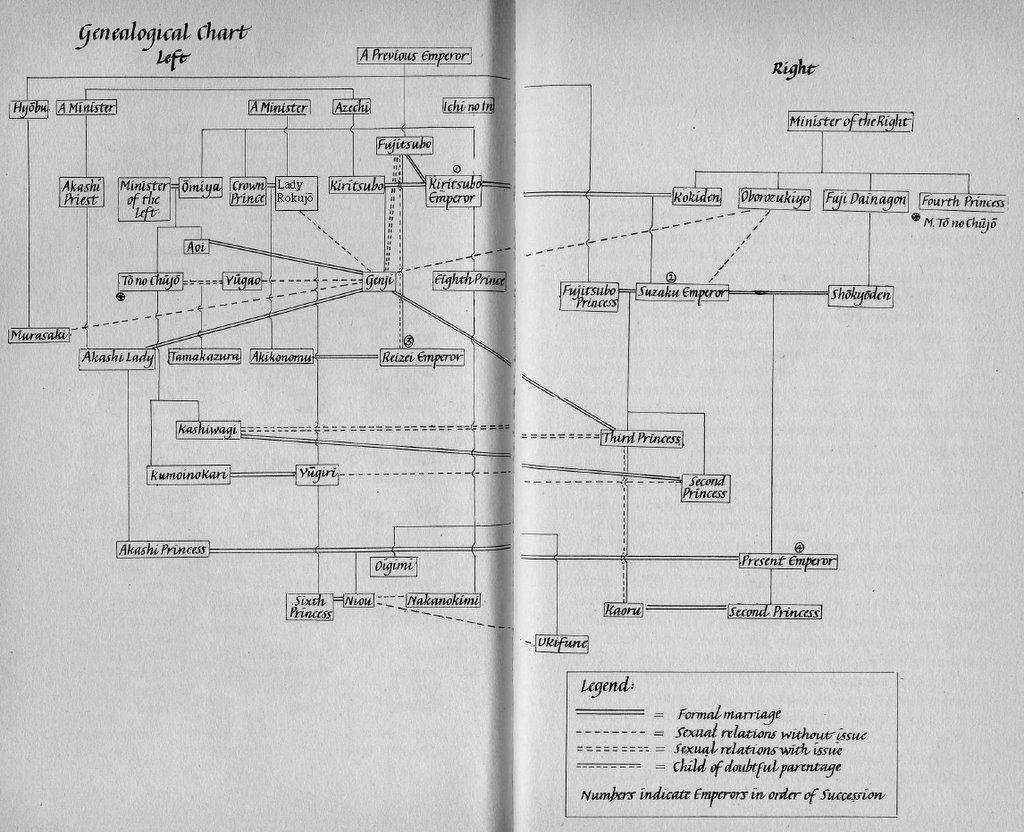
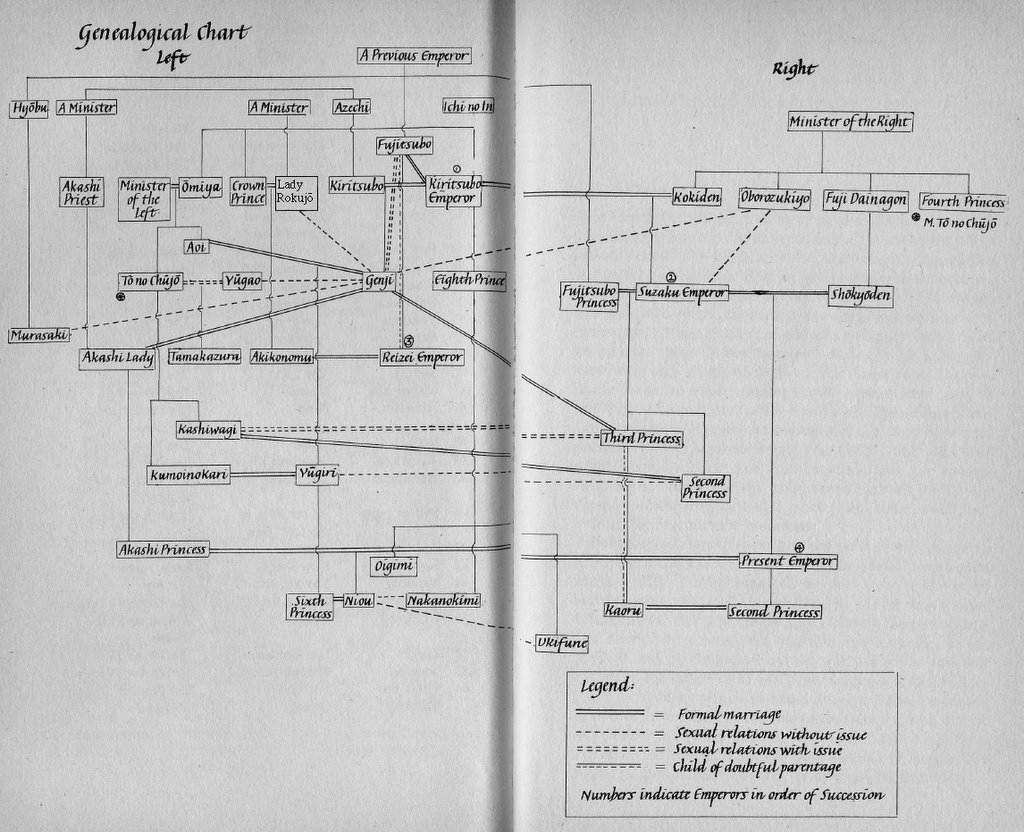
Genealogical Chart
A helpful chart to characters and relationships in Genji is linked here courtesy of the Meiji Gakuin University in Tokyo & Yokohama.

Subscribe to:
Posts (Atom)